
Our Mission
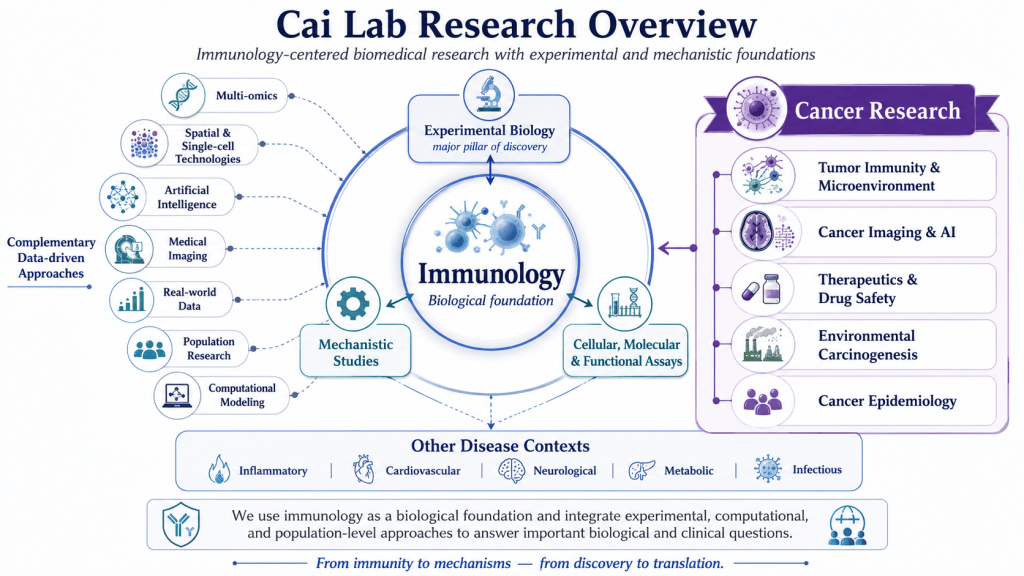
We are an immunology-centered biomedical research laboratory with a strong experimental and mechanistic foundation. We seek to understand how immune regulation, inflammation, and their interactions with tissues, environmental exposures, and therapeutic interventions contribute to the development, progression, and treatment response of human diseases.
Our research combines cellular, molecular, and functional experiments with complementary data-driven approaches. Experimental investigation and biological validation play central roles in our work, while multi-omics, spatial and single-cell technologies, artificial intelligence, medical imaging, real-world data, and computational modeling are integrated when they help identify important biological questions, prioritize mechanisms, or extend discoveries toward clinical relevance.
Cancer is a major cross-cutting research focus of our lab. Our work spans tumor immunity and the tumor microenvironment, cancer-associated molecular mechanisms, therapeutic response and drug safety, environmental carcinogenesis, cancer imaging and artificial intelligence, and cancer epidemiology. We also study inflammatory, cardiovascular, neurological, metabolic, infectious, and other complex diseases in which immune and inflammatory processes play important roles.
We are not defined by a single disease or methodology. We use immunology as a biological foundation, experimental biology as a major pillar of discovery, and computational and population-level approaches as complementary tools to answer important biological and clinical questions.
“From immunity to mechanisms — from discovery to translation.”
Our research is centered on immunology, inflammation, and disease mechanisms, with a strong emphasis on experimental investigation and biological validation. We study how immune and inflammatory processes shape tissue injury and disease progression, how environmental exposures perturb these processes, and how therapeutic interventions influence disease biology.
Our approach is intentionally flexible. Depending on the scientific question, we combine cellular, molecular, and functional experiments with multi-omics, computational analysis, artificial intelligence, imaging, pharmacological investigation, and population-level data. The balance between bench work and computation varies from project to project.
We use immunology as a biological foundation, but tools are not our label; questions are.
We are also not confined to a single disease area. Many immune and biological mechanisms are shared across tissues and disease contexts, so we follow the underlying mechanisms and biological principles rather than the diagnostic label itself.
💡 Some Notes 🧠
We don‘t confine ourselves to any fixed methodological framework — whether “wet lab”, “dry lab”, or “dry‑wet integration”. Every project has its own best path forward. Some questions demand large‑scale computation, others rely on experimental validation, and most of the time they go hand in hand, just in different proportions. We tailor our approach to the question at hand.
The same principle applies to diseases. We are not limited to a particular disease or cancer type because we believe that many biological mechanisms are shared across disease contexts. What matters most to us is understanding the underlying mechanisms and biological principles, rather than being defined by an organ, disease label, or methodological category.
